



Replies within one working day
Book a callCase study · own product · free, open source
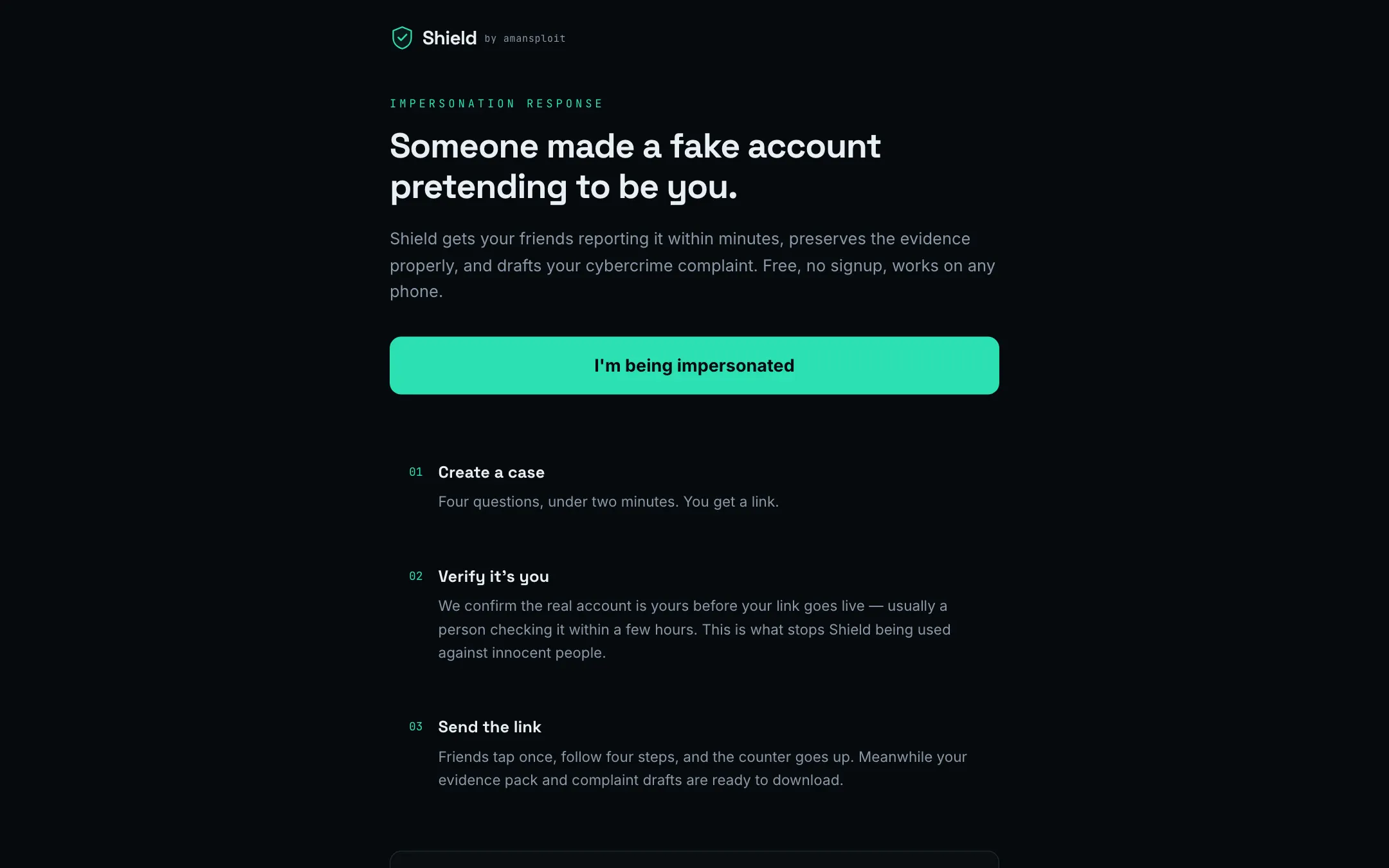
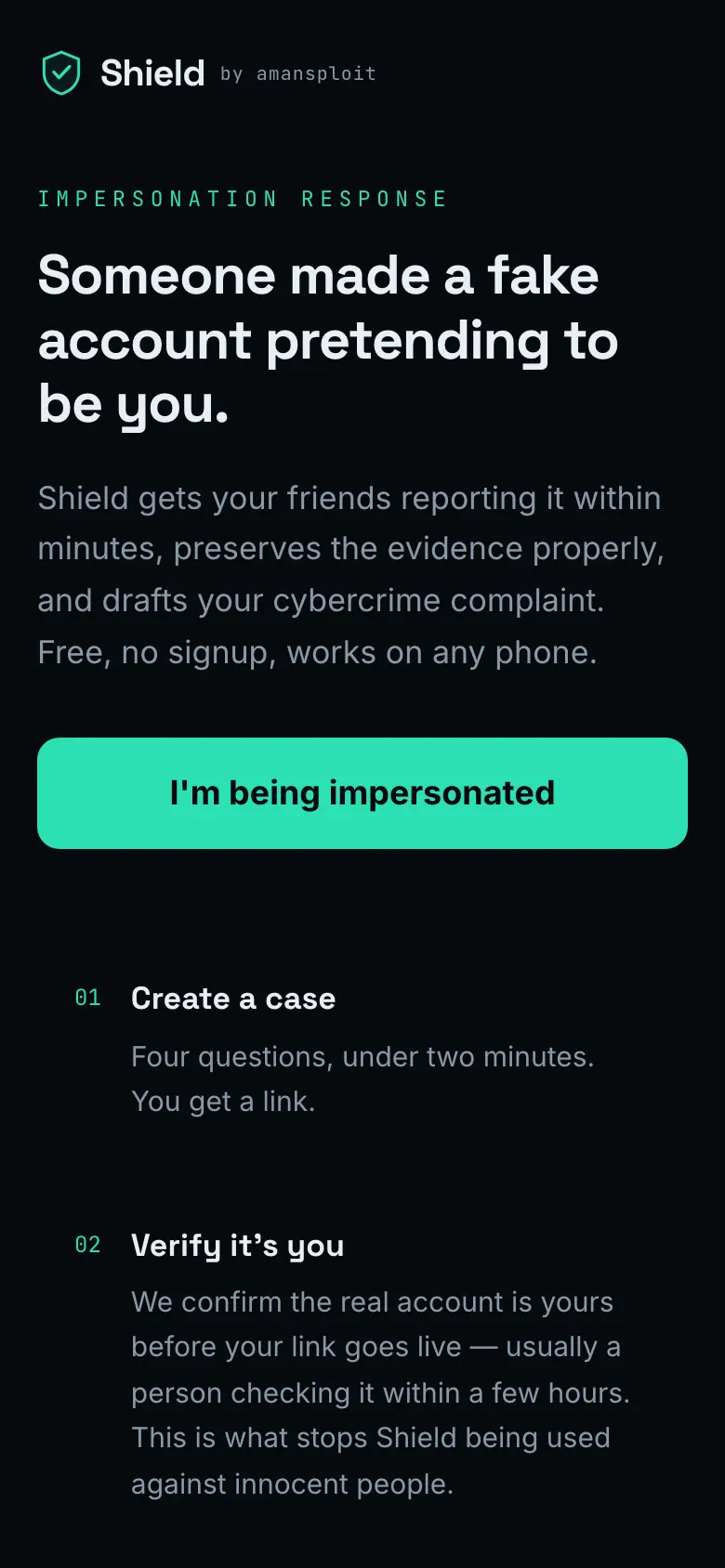
Someone made a fake account pretending to be you.
Shield gets a victim's friends reporting the impersonating account within minutes, preserves the evidence properly, and drafts the cybercrime complaint. No signup, works on any phone. This is my own product, not client work — so the role, the decisions and the numbers are all mine to state.
Instagram has no takedown API.
When an account is cloned, the victim's instinct is to report it once and wait. Nothing happens: a single report from the person being impersonated carries almost no weight, the evidence on their phone is a handful of screenshots with no chain of custody, and the police complaint, if they get as far as filing one, is written under stress with the wrong details in the wrong order.
What actually decides the outcome is three things: how fast a real cluster of people reports the account, how well the official report is written, and whether the victim escalates properly. Shield does those three things and nothing else, and says so on its front page — anyone promising deletion is lying.
A person on a phone, in a bad hour.
The victim is rarely technical and always in a hurry. Every decision below follows from that.
- 01
The person being impersonated
Creates the case, gets verified, sends one link. Four questions, under two minutes, on any phone, no account.
role: primary user
- 02
Their friends
Tap the link once, follow four steps, and the counter goes up. They never install anything or sign in.
role: the cluster that reports
- 03
The officer or platform reading the complaint
Receives a hashed evidence pack with chain of custody and a complaint draft written in the order they expect.
role: the reader who decides
Designed, built, and run.
Everything: the product decision, the case flow, the verification step, the evidence packaging, the complaint drafting, the site, the hosting and the security of all of it. It is the same kind of work I sell — an application with users and sensitive data, attacked before launch — done for a cause instead of a client.
Aman Arvind Sonkamble · Pune
Four calls that shaped it.
Each one traded something away on purpose. They are the kind of decisions a client build gets too, written down.
- 01
Verify the real account before the link goes live
A person checks that the real account belongs to the person creating the case, usually within a few hours. It slows every case down. It is also the only thing that stops Shield being pointed at an innocent person, so it stays.
- 02
Three outputs per case, not a dashboard
A share link for friends, a hashed evidence pack with chain of custody, and complaint drafts ready to download. Nothing to configure, nothing to learn.
- 03
No signup, no app, any phone
The victim is on a phone in a bad hour; a login screen is where they would give up. Every step works in a mobile browser and never asks for a password.
- 04
Say plainly what it cannot do
The front page says Shield cannot delete an account, because no tool can. That sentence costs some sign-ups and earns the trust that makes the rest work.
The whole thing, in the open.
Free and open source, run by me, with a prevention guide beside it. The screenshots are of the live product as it is today.
- 01
The case flow
Create a case, get verified, send the link — with the counter of friends who reported, live on the case page.
- 02
The evidence pack
Hashed at capture, packaged with chain of custody, so what the victim hands over is something an investigator can rely on.
- 03
The complaint drafts
Generated from the case for the cybercrime complaint, in the structure the reader expects.
- 04
The prevention guide
What to set up before anything happens, for the people who arrive early.
Only what the product itself states.
Shield publishes no usage figures, so this page claims none: no user counts, no takedown rates, no time-to-resolution. What can be stated is what the product commits to on its own front page — a case in four questions under two minutes, verification usually within a few hours, and three outputs per case — and that it is live, free and open source. When a number can be checked, it will appear on the Proof page first.
Asked about Shield.
Is this a client project?
No. Shield is my own product, built and run by me, free and open source. It is on this site as proof of the kind of work I do, labelled as what it is.
Why is there no user count?
Because none is published, and this site does not invent numbers. The Proof page lists exactly what can be checked.
Can Shield delete an impersonating account?
No tool can. Instagram has no takedown API. Shield speeds up the reports that do get accounts removed, preserves the evidence, and drafts the complaint.
What does it have to do with the work you sell?
It is an application with users and sensitive data, designed and built by one person and security-reviewed before launch — the same thing a client gets, done for a cause.
An application built by someone who knows how it will be attacked.
Tell me what you're building. I reply within one working day; the first call is a free 15 minutes.